One Year Of Blogging // 10 Truths And 2 Lies


September 12, 2017


   Whoa.

   I've officially been blogging for one year now. Can you believe that? Because I can't xD.

one year of blogging and ten truths and two lies [header image]


   My first year of blogging has been AH-MAZING, and you guys were definitely the biggest part of it. I'm so so thankful for all of you that read and comment on my ramblings. You're all incredible *hugs*.

   Special thanks to Christine Smith and Katie Grace, who were the first to show me that there's an epic community of blogging writers out there. I know that my first-ever comment on a bigger blog was on one of yours ... I just can't remember who's xD. But you're both amazing, and you continue to inspire! And special thanks also go to Go Teen Writers, who helps tons of teenage writers (including me!), and I probably wouldn't be where I am without them. And LASTLY (but not least!), to my sister Ariel, who should be credited for a lot of my book pictures on Scattered Scribblings. I hold the books, she takes the pictures xD.

   I wish I had the time to thank ALL of you, I really do, but then this post would get so long! But y'all should know that I appreciate every single one of you like crazy, and all of your comments never fail to make me smile. ;)

Stats from my first year of blogging: 


   followers (between GFC and email subscribers): 135
   page views: 40k
   posts: 96
   most popular post: to all the young writers (okay, so it's the second most popular - but it's also one of my favorites, so)   

   Alright, alright - let's skip the rambling and get straight to the point of this post.

   I'm finally doing 10 truths and 2 lies!


   The rules to the game are easy - I'll be posting 12 facts about me, and ten of them will be true while two of them are actually lies. Your job is to figure out which two you think are lies, and post them in the comments below! I've seen other bloggers play this game, and it's always a ton of fun - though I'm afraid I don't have a prize to offer to the winner like most of them do - but you can go enter the giveaway that's still running! And if you enter the giveaway and guess the lies correctly, I guess I'll give you three extra entries into the giveaway xD.

   Better channel your inner Sherlock Holmes, bloggers.


   1. I wear contacts 

   2. I sleep with a notebook and pens under my pillow 

   3. I own less than 50 ebooks

   4. I kept a dream diary for four years 

   5. I had a private blog before I started Scattered Scribblings 

   6. I'm not an early bird. 

   7. I've ridden on a Ferris wheel and a rollercoaster. 

   8. I'm a quarter Korean 

   9. I've only read the Harry Potter series once. 

Harry Potter And The Sorcerer's Stone Book Picture


   10. Buffalo chicken pizza is a my favorite 

   11. I rarely buy notebooks 

   12. I've purposefully ripped up books before  


   There you have it - I did my best to make the lies hard for you guys to guess, so I suppose we'll see how sneaky I was once this ends! You have until the 23th to comment your guesses - I'm curious to see which of these you think are lies! xD

~ Savannah Grace

thanks for sticking with me for a whole year, you're so epic <3

Five Ways To Strengthen Your Novel's Beginning - a guest post by Jane Maree


September 9, 2017


   Morning, readers! It's finally time for the first guest post of my blogoversary bash! The lovely Jane Maree (who recently started her author website, so you should check her out) is here to tell y'all about strengthening your novel's beginning. So I'll step out of the way so you can hear her wisdom, yes? ;)

   *exit Savannah*  


Picture this: you come up with a stunning idea for a novel. You plot it all out (or don’t, depending on your personal method :P) and you sit down, fingers ready to start this wonderful new story.
But then there comes the flash of horror. You have to actually begin it. But how?? What should you start with? Where and when should you begin? How will you make it just right?
I don’t know about you, but I know that beginnings are one of the hardest parts of writing for me. Just that first scene. Once I’m past it I can go fine, but starting that first scene is like face-planting in pizza sauce and trying to swim. (I don’t recommend trying this.)
The beginning of your story is crucial to hooking in your readers and trapping them inside your story. There’s so many important details to include and juggle and try to include without making it too much.
Today I’ve got a list of five ways that you can strengthen your beginning. This is by no means covering everything, but…it’s a beginning.

1: Start with character

Character is about 75% of nailing your opening scene. Beginnings are all about character. The characters are what will keep your audience hanging on the edges of their seats. They won’t be invested in your story if you don’t give them someone to cheer for. So you need to do this right at the very, very beginning.
In the first scene of your novel, you need to introduce your readers to your protagonist and give them a reason why they should care about what happens to him. Some of the most stunning books I have ever read, are amazing because of the characters. Without strong characters to care about, why would your readers bother to keep reading?
The very first scene in your book should be the Characteristic Moment (more about that later). First impressions are hugely important. Your character can’t get interesting ‘later’ because if your readers are uninterested in the first chapter it’s ten times harder to recapture that interest ‘later’—if they even bother to keep reading.
“My knuckles dimple as I gather my full skirts and offer Father a pretty curtsy. I am breathless from running down the stairs to greet him, although, in truth, my breathlessness is mostly from my plumpness, which is the effect of too many sweets these past three years. My old maid Hazel…calls it baby fat, but that is her love for me speaking. I know better.” –A Wish Made of Glass, Ashlee Willis
[several words excluded from quote to avoid slight spoilers]
In this paragraph, Ashlee introduces the readers to her main character and already gives that layer of relatability to her. Because really, who hasn’t had the problem of too many sweets? :P

2: Find the balance between action and boredom

Some of the most prominent writing advice that I have heard about beginnings is something along the lines of: “start with action” “make it begin with a bang.” Though it’s true that having a gripping hook is important, it’s also very important not to just slap your readers in the face with a bunch of action. There is a certain amount of context that is needed in every story. If you simply begin your novel in the middle of a fistfight in a back alley, your audience will be confused. Who should they root for? Why are these people fighting? What in the world is going on with this story?
Going back to point number one, using character is a great way to balance out the action and boredom. Starting with a fistfight in an alley is fine in itself, but without a character to draw readers into your story it’s going to fall flat. Another way as well as characters, is to include context. Including context via the character mixes the two together and works very well for creating a strong beginning.
“What can I say? I'm a moron.
I knew better than to play ball in King Coat's territory. Maybe I was looking for a fight, wanting to blow off steam after my “talk” with Principal McKaffey.” –The New Recruit, Jill Williamson
In this example, Jill Williamson uses a great beginning to her story. Spencer (the main character) is in the middle of a fight with some other boys and it works wonderfully for this story. She uses characters to draw the reader in, and weaves in context and setting and backstory so artfully. Over the next few pages she balances the action and the necessary context in a way that flows, makes sense, and draw the reader into the story.
I’d highly recommend finding a preview and reading her first chapter at least (goodreads and amazon both have samples), as it has many more examples of how to handle this well.

3: Use the goal/conflict/disaster pattern

This is the proper scene structure for every single scene. Your character has a goal, something is standing in the way of that goal, and a disaster (big or small) happens because of that. Your beginning needs to have a structured flow just like all your other scenes, and following this will majorly help to keep it from being a jumbled mess.
Added to the basic sense of structure this will give your scene, this also helps with my second point. Because this requires the presence of conflict so it assures that there is no reason for boredom.
“The screw through Cinder’s ankle had rusted, the engraved cross marks worn to a mangled circle. Her knuckles ached from forcing the screwdriver into the joint as she struggled to loosen the screw one gritting twist after another. By the time it was extracted far enough for her to wrench free with her prosthetic steel hand, the hairline threads had been stripped clean.” –Cinder, Marissa Meyer
This is the beginning paragraph of Cinder. The rest of the first chapter is a good example of the goal/conflict/disaster structure. For those who haven’t read the book, I’ve keyed down the spoilers as much as possible and it shouldn’t be a problem, but feel free to skip the next paragraph.
Cinder’s goal is to get her new foot attached and move on with her mechanic business like any normal day. Conflict comes into play when A Certain Important Guy turns up with his android. Cinder wants to hide the fact that she’s a cyborg but she currently has no foot attached to her ankle, and the tension runs high through the scene as she tries to hide the fact. This is the disaster section. In this particular example, it all turns out okay, but many other scenes in both Cinder and other books have a much more disastrous ending to the scene.
Because of this structure, the first chapter of Cinder works very well in introducing enough information and having enough happening at the same time to draw in the readers.

4: Introduce Your Story

This might seem a little obvious, but it’s similar to point two. You need some context for your story, and not just so that your readers understand. You need the context as a set-up for the plot and the story as a whole.
“Flying a biplane, especially one as rickety as a war-surplus Curtiss JN-4D, meant being reading for anything. But in Hitch's thirteen years of experience, this was the first time “anything” had meant bodies falling out of the night sky smack in front of his plane.” –Storming, K. M. Weiland
From just that one paragraph, Weiland introduces so much about the story, the character, and the setting, and also plants question in the readers’ minds that keeps them reading. Why is there bodies falling out of the sky?? Good question. That’s what the story is all about.
Aside from what we’ve already covered, the beginning should introduce your…

‘Normal’ World and Setting:

This is good context to explain why everything is happening how it is. Without this knowledge, a half-blood boy vaporising his maths teacher with a pen/sword is going to make no sense at all. This also sets up for a powerful contrast later on in the story.

Overall tone:

This is where you show your writing style and the feel of your story. You want readers to be able to open your book, scan over the first page, and be able to see whether or not they like your style.

Protagonist’s motivation and conflict:

Basically, you’re introducing the main conflict and plot line that will continue on through the whole story. Similar to what I said in point two, your beginning can’t just be introducing a character, it does have to introduce your dilemma/conflict. You don’t need to bring in the main villain of the story, but you do need to start off the plot right away because if you don’t have a plot in your first chapter, what’s to make the readers know that you will later? Even if all you include is just the smallest thing that creates a nagging question in the reader’s minds and they simply can’t put down the book without reading it all to discover the answer.

5: Include theme

“But it’s only the first chapter! Do I have to have theme in the first chapter?”
Yes. You absolutely do. Theme is a massively important part of every novel. You can have a brilliant cast of characters, a stunning plot full of twists and surprises, a well-developed story world, but if you haven’t got a strong theme, it’s not going to truly affect your readers on a deep level.
The Characteristic Moment that I mentioned in my first point is the set-up for your character arc. It should show your readers where your character is at and how he views the world. If your theme is hope, the characteristic moment lets the readers know that your protagonist doesn’t think hope is even worth the time. If your theme is courage, maybe it shows your protagonist running away from conflict instead of standing up for what’s right. This sets out a foundation for the rest of the story—plot-wise and theme-wise as the Quest and the Arc continue.
In much of the modern literature I’ve read—be it published books or alpha/beta novels I was critiquing—there is a tendency to leave the theme and character arcs until further along in the story. The second or third chapter is more likely to include a little bit of theme, but the first is usually sadly lacking.
With this, it’s the same as having a good plot, or good characters. It needs to be in there right from the beginning to show your readers that this story is one of those stories that really do matter.


      how are you doing with your novel's beginning? 
which is easier for you to write - the beginning or the end?
   go ahead and chat with Jane in the comments!
  

7 Books For Your Fall Reading List + 7 Books On Mine


September 7, 2017


   The beautiful season of AUTUMN has arrived, you guys! Finally, we can stop melting in the Summer heat but I bet I'll be begging to get the lazy days of Summer back soon enough  It's now time to break out the pumpkin spice, the warm sweaters, and the 600-page adventure books.

   (need more book recommendations? I did a post on 7 books for your summer reading list too, back in June. And I won't be adding any of those books to this list, even though the Harry Potter series basically screams 'Fall read' xD)  

7 books for your fall reading list + 7 on mine


   Fall stories are giant, adventurous, beautiful YA books that you'll want to dig into while curled up in a comfy chair, because it's going to be a LONG read (which will probably keep you up into the wee hours of the morning). Fall's the perfect time to find those big books and series that are a little too heavy for the binge-reading months of Summer - so here I am to shove seven Autumn-perfect books on your tbr! 

the fellowship of the ring book picture


   And of COURSE this one's on the list! Honestly, it's the first book that comes to my mind when I think 'Fall books' - though Harry Potter DOES trot along pretty close behind it! xD

   The entire journey starts in the Fall (September 22nd, to be exact), and it just feels like a Fall trilogy! And of course there's plenty of adventure involved, so The Lord Of The Rings is an epic book to read when the leaves start falling ;).

the girl who drank the moon book picture


   I just read The Girl Who Drank The Moon last month, and I can TOTALLY see why it won a Newberry award! (don't be fooled by the absence of The Gold Sticker on my copy of this book - our library copy has a beautiful Newberry award on the front xD)

   It's a beautiful, adventurous book with just a touch of mystery around it. It'd be the perfect thing to crack open and start on a beautiful Fall night. And it's not a MASSIVE book (though it still is a pretty good size), for all of you who are daunted by all the 600-page books that decide to make appearances in the Fall xD.    

inkheart book picture


   Three great, big, thick books that are all ABOUT a special book? Yes, please! The Inkheart trilogy is absolutely perfect for this list (and you actually have the chance to win it, as I'm currently holding a contest in which Inkheart is the prize!).

   The characters in this trilogy are amazing, I love them so much. And Inkheart just has a Fall FEEL to it! It definitely deserves a spot on your Fall tbr. And each book in the trilogy is pretty big, so make sure you have a lot of time on your hands before you dig into this series!  

inheritance book picture


   So, Eragon gets a lot of hate half the time. I don't know why. I can definitely see where people are coming from (because yes, the cycle DOES start off like Star Wars), but still! It's a very creative series, the prose is beautiful, and it's the perfect (GIANT) series to dig into during Autumn. 

   Also ... it has dragons. Everything is better when dragons are involved xD. 

the boy who lost fairyland book picture


   Alright, so I DID include a book from this series in my Summer recommendations list (The Girl Who Circumnavigated Fairyland In A Ship Of Her Own making - which I'm giving away a copy of right now!), but I'm going to mention this one anyways. It's the fourth book in the series, and even though it's on the shorter side, it would still make an epic fall read (especially for those of you who don't have the time to commit to a massive series!).

   But I should warn you that it's not really a standalone, so you'll ... uh, have to read the whole series. *piles it onto your tbr*  

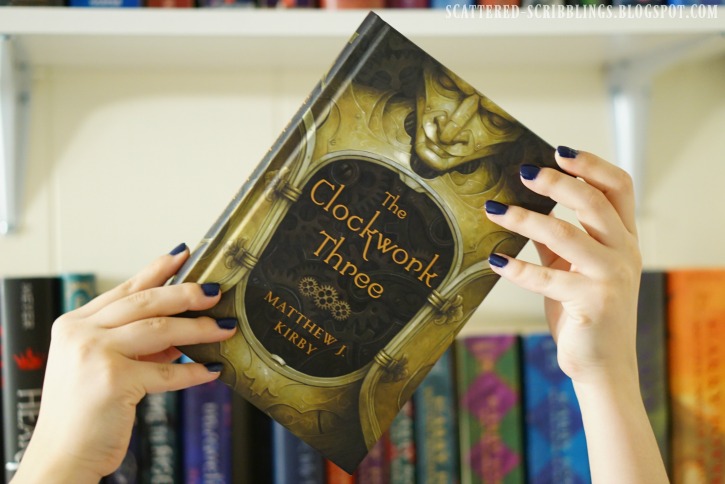
the clockwork three book picture


   Okay tell me that cover doesn't make it a Fall read. Just look at the color scheme going on <3. But besides that (can anyone tell I'm mildly biased by cover love? xD), The Clockwork Three is an amazing read. The characters are some of the best I've read, I love them so much <3.

   And besides the epic characters, The Clockwork Three has an INCREDIBLE plot! I can't tell you much without giving away spoilers, but this is definitely a book you're going to want to read this Fall ;).

the unwanteds book picture

   I kid you not, this series could probably keep you busy for a good deal of Fall. It's eight books long, and all the books are MASSIVE (as in the-last-books-in-the-Harry-Potter-series massive). The Unwanteds series is MG dystopian, but it's nothing like your typical dystopian series, so I LOVE it.

   Also ... all the covers in this series are seriously epic. Just sayin' xD.  


   And now that I've shown you guys seven gorgeous books for YOUR tbr, shall we take a peek at seven on mine? I'm only featuring the books that I physically have in my house right now, so this is only a teeny portion of what I hope to read this Fall ...

fall books collage
+ Splintered by A.G. Howard

   And like I said, these are only the books that I physically have right now, so I couldn't include the ones I'm still waiting for (*cough* The Color Project and Renegades *cough*) - which might be a good thing, because then my tbr would be a mile long! And ... I actually managed to finish one of these seven books before I finished this post. Oops? But Forest Born was an amazing read, so I don't even care xD.

   The Scorpio Races and Four (and Splintered) are actually books that I've owned for a little while now, and I STILL haven't read them, so I definitely need to (especially with how much everyone races about Maggie Stiefvater's writing)! Jackaby, Forbidden, and Emissary are three books that I picked up from the library (WHICH MEANS READING DEADLINES), and I'm super excited to dig into them! I have a very distinct feeling that all of these are going to be amazing. 

   ANYWAYS. I'm really really excited to read these books! They look like the perfect books for Autumn, and I'm already ready to curl up in a chair on a Fall evening and finish these gorgeous things.       

   Have an epic Fall of reading, my friends!

~ Savannah Grace 

what books are on your autumn to-be-read list?